Some of Africa’s most interesting technology companies are being built around problems that sit beneath the surface of everyday life — how chips are designed, how businesses manage people, how financial institutions serve customers, and how waste moves through an economy.
Five startups working on those kinds of problems have now joined Madica, an Africa-focused pre-seed investment programme designed to support founders who have historically had less access to early-stage capital.
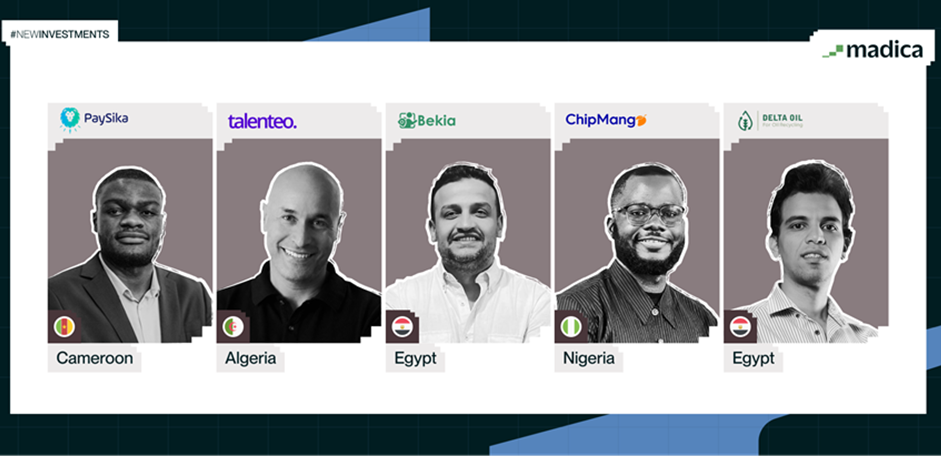
The new investments take Madica’s portfolio to 18 companies and, importantly, expand its reach into Algeria and Cameroon for the first time. The five startups are Talenteo from Algeria, Paysika from Cameroon, and Nigeria’s ChipMango, alongside Egypt’s Delta Oil and Bekia.
Each company will receive up to US$200,000 and enter an 18-month programme combining investment with mentorship, executive coaching, founder immersion trips and access to Madica’s global investor network.
The companies are tackling very different markets, but they share something in common: they are building infrastructure around sectors that African economies increasingly depend on.
In Nigeria, ChipMango is working on one of the continent’s emerging technology frontiers — semiconductors. The startup is developing chip design services, engineering education and localised Edge AI products, placing it within a sector that could become increasingly important as African countries look to develop more technological capacity locally.
In Algeria, Talenteo is building an all-in-one human resources management platform, while Cameroon’s Paysika is developing a digital neobank. Their inclusion also marks Madica’s first institutional investments in both countries.
Egypt’s two new portfolio companies are addressing another side of the infrastructure challenge. Delta Oil is building systems to connect fragmented used-cooking-oil collection networks with international buyers, while Bekia is developing a digital platform for the collection layer of Egypt’s recycling economy.
Taken together, the five businesses show how African technology is moving beyond a narrow definition of the startup economy. The opportunity is not only in building consumer apps or financial products. Founders are also creating technology for industrial systems, recycling, human resources, banking infrastructure and advanced hardware.
For Madica, the geographic expansion is equally significant. The programme launched in 2022 with a focus on underrepresented and underfunded founders, and its latest investments take its total portfolio from 13 to 18 companies.
The programme argues that venture capital remains concentrated in a small number of African startup ecosystems, leaving capable founders in other markets with fewer opportunities to access institutional funding and company-building support.
Its first investments in Algeria and Cameroon are therefore not simply additions to a portfolio. They represent an attempt to widen the map of where venture-backed African technology companies can emerge.
That matters because some of the continent’s most important innovations may not come from the markets that already receive the most attention. They may come from founders building quietly in places where venture capital has historically been harder to find, solving problems that become more important as those economies grow.
With the five new companies, Madica is betting on that wider pool of African founders, and on businesses building the systems, technologies and infrastructure that could shape the continent’s next phase of growth.




More Stories
Toroti Akogun Is Reimagining What HR Professionals Can Do With AI
Across AI Raises $5.75 Million to Help Businesses Turn Scattered Data into Actionable Intelligence
Nigerian Fintech Yellow Card Expands Into Canada, Extending Its Global Payments Network