

When Olusola Amusan talks about technology, his work is rarely confined to software.
His career has moved across technology, education, workforce development, migration, finance and artificial intelligence, with a recurring interest in how systems can make access to opportunity easier for people.
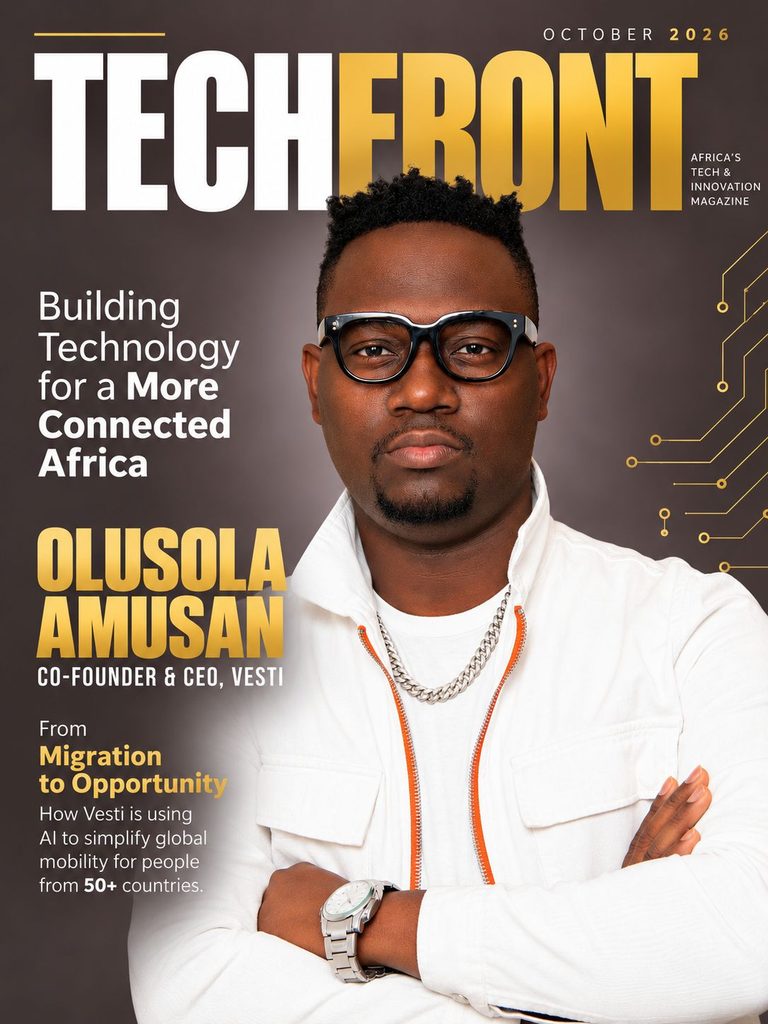
That approach is most visible in Vesti, the company he co-founded and leads as CEO. Vesti is an AI-powered super-app for immigrants, built to simplify the process of relocating for education and work. The platform has supported more than 150,000 users moving to North America and Europe.
At first glance, Vesti may seem like a company built for people leaving Africa.
Look more closely, however, and another story emerges.
For Amusan, migration is not simply about people leaving one country for another. It is about what happens when talented people have to navigate complicated systems simply to access education, employment, financial services and a better quality of life.
And that is a problem he understands particularly well because much of his work has been shaped by the African experience.
Amusan has spent years working around the question of access: access to technology, access to skills, access to education, access to capital and access to opportunities that can change the direction of a person’s life.
Even while living between Lagos, Dallas and San Francisco, his work continues to return to Africa, and particularly Nigeria. That may seem paradoxical. Why build for Africa while living outside it?
For Amusan, geography does not necessarily determine where a problem belongs.
Technology has made it possible to work across borders, and his own career reflects that reality. He has worked with organisations including Microsoft, Amazon Web Services, the World Bank, Shell, Sterling Bank, First Bank, GIZ and Ashoka, gaining experience across technology, workforce development and social impact.
Those experiences exposed him to different sides of the same challenge: Africa has people with ability and ambition, but too many of the systems around them make it unnecessarily difficult to turn that ability into opportunity.
Nigeria, in particular, has no shortage of young people who want to learn, build businesses, work internationally, develop technology or create solutions to problems around them. What is often missing is the infrastructure that helps them move from potential to participation.
That is where much of Amusan’s work begins.
His interest in technology has never been limited to creating another application or introducing another digital product. He has increasingly worked on systems that sit underneath people’s everyday experiences.
Vesti is one example. The platform addresses the complicated process of migration by bringing together services that immigrants often have to find and navigate separately. Its users come from 50+ countries, but its relevance to Africa is particularly significant because migration remains closely tied to education, employment and economic opportunity for many Nigerians and other Africans.
The same concern appears in Amusan’s work in education.
Through Curators University, he has pursued the development of an institution focused on indigenous technology and learning. The idea is important in an African context where education has often prepared people to become consumers of knowledge created elsewhere, while the continent continues to need institutions capable of producing its own technology, research and intellectual property.
There is a similar logic behind his work in other sectors.
Blackshore explores AI-native hardware. White Storks represents a long-term vision around African wealth management and capital. His academic research examines artificial intelligence and biometric surveillance, including how emerging technologies can be applied in environments where security, privacy and human rights have to be considered together.
Different industries, but a similar question. What systems do Africans need to participate more fully in the world that is being built?
It is a question that helps make sense of Amusan’s otherwise unusually broad portfolio.
His background as a software engineer explains his ability to build technology. His work with global institutions exposed him to large-scale systems. His experience in education and workforce development gave him a closer understanding of the gap between talent and opportunity. His work in artificial intelligence places him inside one of the technologies that will increasingly determine how economies function.
Put together, those experiences have produced something more than a conventional technology entrepreneur.
They have produced a builder who appears to think in systems. For Nigeria, that matters.
The country’s biggest challenges are rarely caused by a lack of intelligent people. They are often problems of infrastructure, coordination, access and institutions. A young person may have the talent but lack the network. A founder may have a viable idea but struggle to access capital. A student may have the ability to compete globally but lack the systems that connect them to the opportunity. A professional seeking to relocate may spend weeks navigating processes that technology could make simpler.
These are not isolated problems. They are connected. And Amusan’s work reflects an understanding of that connection.
His own movement across countries has not separated him from the problems of the continent. If anything, it has given him the ability to see some of those problems from both sides: as someone familiar with the African context and as someone operating within global technology and business ecosystems.
That perspective is visible in Vesti, where a deeply African experience, migration, has become the foundation for a company serving people across the world.
It is also visible in his interest in education, artificial intelligence, hardware and finance, areas that will determine whether African countries merely participate in the digital economy or have a meaningful role in shaping it.
For Amusan, the question is therefore larger than where he lives. It is about what he chooses to build.
And across the different ventures, institutions and ideas associated with his work, there is a consistent interest in making systems work better for people who have historically had to navigate them with too little support.
That is particularly relevant for Nigeria, a country with one of the world’s youngest populations and an enormous pool of talent, but also with significant gaps in infrastructure and access.
The challenge is not convincing Nigerians that they can do more. It is building the systems that make it possible for more of them to do it.
That is the space in which Olusola Amusan has chosen to work.
From migration technology to education, artificial intelligence, hardware and finance, his work may span very different fields, but the question underneath remains remarkably consistent: how can technology and better systems make opportunity easier to access?
It is a question that follows him across borders.
He may live outside Africa, but distance has not separated his work from the problems that shaped his understanding of Africa. If anything, operating across different environments has given him a wider view of what is possible, and a clearer understanding of what remains missing.
For Amusan, solving African problems does not necessarily mean being physically present in Africa every day. It can mean building companies that respond to African realities, creating institutions that develop African talent, and designing technology that allows people who have historically had to navigate broken or fragmented systems to move with greater ease.
That brings the story back to where it began. His work has never really been about software alone.
It is about what happens when technology is used to remove barriers between people and opportunity.
And whether the problem is a young Nigerian looking for a pathway into the global economy, an immigrant trying to navigate a new country, a student seeking relevant education, or an African entrepreneur trying to build at scale, Amusan continues to approach the problem in much the same way: understand the system, identify where it fails people, and build something better.
That may ultimately be the thread connecting the different parts of his work. Not the companies. Not the sectors. Not even the technology.
The people who are trying to move forward, and the systems that should help them get there.




More Stories
Toroti Akogun Is Reimagining What HR Professionals Can Do With AI
Across AI Raises $5.75 Million to Help Businesses Turn Scattered Data into Actionable Intelligence
Nigerian Fintech Yellow Card Expands Into Canada, Extending Its Global Payments Network