
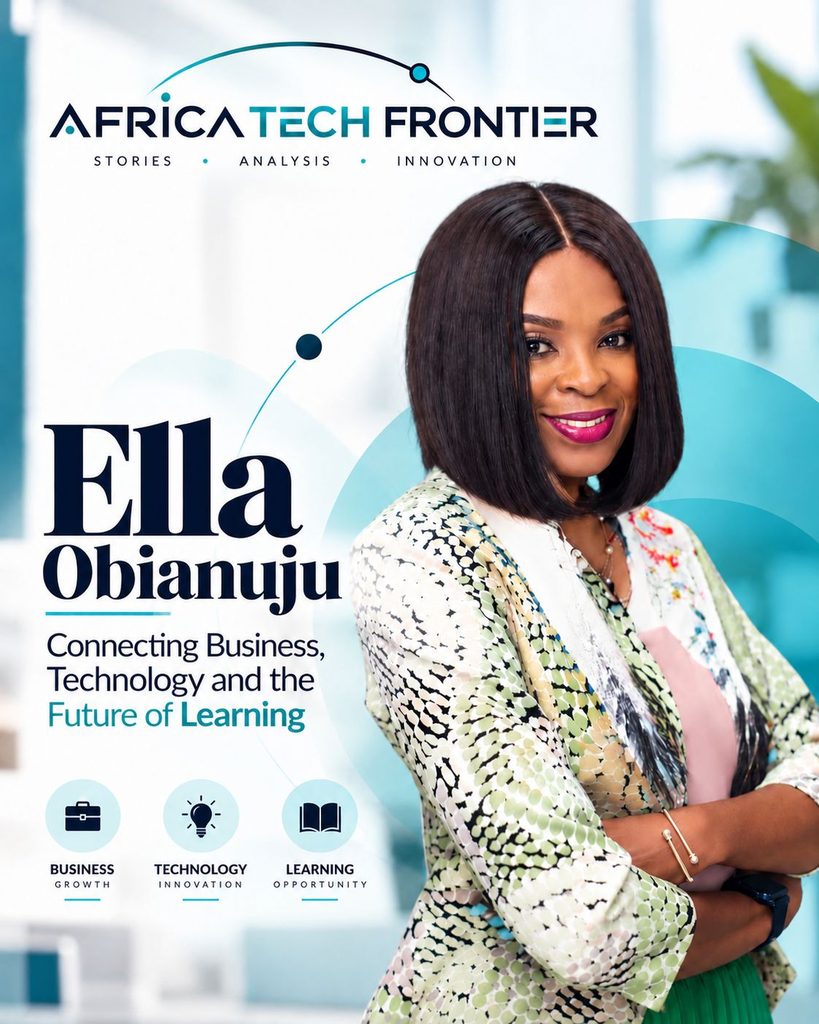
Some career journeys become interesting because of the positions people hold. Others stand out because of the connections between the different things people have done. When I look at Ella Obianuju’s journey, what catches my attention is how she has moved from the arts into business and technology while also building an education venture of her own. Her story offers an opportunity to think about the value of transferable skills, the possibilities that come with continuous learning and how seemingly different interests can contribute to a larger professional journey.
With more than 18 years of experience across telecommunications, enterprise sales, digital financial services, education and technology, Ella has developed a career that extends beyond a single professional identity. She currently serves as Chief Innovation Officer at MCC Digital Lab, with a focus on FliPAAS and SaaS innovation, and is also the founder of FliplearnKids, an education venture established in 2016.
Her journey offers an interesting starting point for a conversation about career transitions. Ella studied English Language and Dramatic Arts at the University of Nigeria, graduating in 2001. At first glance, this may seem far removed from enterprise sales, cloud services, 5G technology and digital product development. But I think we sometimes underestimate how much our education prepares us for opportunities beyond the careers we initially imagine.
The arts teach us to understand people, interpret experiences, communicate ideas and tell stories. These skills are not useful only on a stage or in a creative profession. They matter in business, too. In sales, for instance, you need to understand what people need, communicate the value of a solution and build relationships that inspire trust. In leadership, you need to communicate a vision and bring people along with you.
When I consider Ella’s transition from the arts into business, I am reminded that our degrees do not have to determine our destinations. What we learn in one field can become valuable in another. A background in the arts does not have to be discarded when someone enters the corporate world; the skills developed through that education can become part of what makes them effective there.
Ella built her corporate career at MTN Nigeria, working across sales, distribution, customer acquisition, digital financial services and enterprise business development. These roles exposed her to different aspects of business, from understanding customer needs and managing partnerships to developing strategies for growth.
Her experience in digital financial services included working as Regional Implementation Manager at Yello Digital Financial Services, where she worked with 21 strategic financial partners. She subsequently took on responsibilities in B2B and wholesale channel management before becoming Head of Value Sales in MTN Nigeria’s Enterprise Business Unit in March 2023.
In that role, she worked across enterprise sales strategy, strategic partnerships and technology solutions involving cloud services, data hosting, colocation, 5G and the Internet of Things. She also led an inside sales channel growth initiative that tripled sales and revenue within a year.
These experiences reflect an important part of her professional development: the ability to combine relationship-building with commercial thinking. As technology changes the way businesses operate, organisations need people who can understand both the capabilities of a solution and the problem it is meant to solve. Technical knowledge matters, but so does the ability to communicate value, recognise opportunities and build partnerships that help ideas move forward.
Ella has also continued to invest in her own development, earning a Master of Business Administration from the University of the People in 2022 and pursuing further training in areas including cloud computing, business analysis and artificial intelligence. Her professional development reinforces an important lesson: learning does not end when we leave university. As our responsibilities grow and industries evolve, we must be willing to acquire new skills, ask questions and explore areas that may once have seemed unfamiliar.
But there is another side to Ella’s story that I find equally interesting.
Alongside her corporate career, Ella has been building FliplearnKids, the education venture she established in 2016. While developing her expertise in business and technology, she was also creating something of her own in a completely different space: education. I find this particularly interesting because it reveals another dimension of her work, one that goes beyond enterprise sales, partnerships and technology solutions.
Through FliplearnKids, she is exploring how children learn, how educators teach and how technology can make learning more practical, engaging and accessible. And I think this is worth paying attention to. Sometimes, when we look at someone’s professional journey, we focus so much on the positions they hold that we miss the other things they are building and the different ways they are choosing to apply their knowledge.
FliplearnKids is built around three ideas: Learn, Interact, Do. Through programmes covering areas such as coding, digital skills, creative writing and technology education, the initiative encourages children to move beyond simply receiving information towards engaging with ideas and applying what they learn.
This approach matters because learning is about more than what a child can remember. It is also about what that child can understand, explore, create and do. As technology becomes increasingly important in everyday life, children need opportunities to develop practical skills and confidence in using them.
There is also the question of access. A child’s opportunity to learn digital skills should not depend entirely on the financial circumstances of their family. Through initiatives associated with her education work, including Inspire a Child, Ella has been involved in efforts to provide children from low-income backgrounds with technology skills and mentoring. The initiative has been reported to have reached more than 2,500 students.
For me, this adds another dimension to the FliplearnKids story. It is not simply about introducing technology into learning; it is also about helping children encounter possibilities that may broaden their understanding of what they can become. Exposure, encouragement and access to practical learning can help a child discover an interest or ability they might not otherwise have had the opportunity to explore.
Now, when I look at these different parts of Ella’s life, I begin to see how they can connect. Her corporate career has involved understanding customers, developing value propositions, managing partnerships and identifying opportunities for growth. Her education work calls for an understanding of learners, educators and the practical challenges of creating meaningful learning experiences. Although the settings are different, both involve recognising a need and thinking about how to respond to it.
And this brings me to another important chapter in her journey: SaaS innovation.
At MCC Digital Lab, Ella’s current focus includes software-as-a-service (SaaS) products, particularly FliPAAS, a visitor management platform. As Chief Innovation Officer, she is contributing to this new frontier in the company’s technology work, where the focus is on developing digital solutions that address practical business needs.
SaaS is changing how organisations access and use technology. Rather than relying entirely on traditional software installations and infrastructure, businesses can access software solutions designed to meet specific operational needs. For organisations looking to improve efficiency, streamline processes and adopt digital tools, these solutions can play an important role in how they work.
Visitor management may seem like a small part of running an organisation, but it touches on important operational questions: how visitors are received, how their information is managed, and how organisations maintain visibility over who enters their premises. A digital visitor management platform can help bring greater structure and consistency to these processes.
What makes this new frontier particularly interesting is the opportunity to build technology around real business needs. Innovation is not just about creating something new because the technology exists. It is about identifying a challenge, understanding the people who experience it and developing a solution that makes their work easier or more effective. This is where business understanding and technology can meet in a practical way.
For Ella, this chapter also draws on the experience she has accumulated across enterprise sales, technology solutions, customer relationships and strategic partnerships. Building awareness of a SaaS product involves more than explaining its features. It also requires communicating the problem it solves, the value it offers and the reasons an organisation might consider adopting it.
When I consider this next chapter of her career, I see how her experience across business and technology can contribute to a broader understanding of innovation. Developing and positioning digital products requires commercial awareness, collaboration and the ability to connect ideas with the needs of the people and organisations they are intended to serve.
What I find particularly interesting is that the businesswoman, the education entrepreneur and the technology innovator do not have to compete with one another. They are different parts of the same professional story. Her education, corporate experience and work in learning may appear to belong to separate worlds, but together they offer different perspectives that can inform how she approaches new opportunities.
And perhaps this is where we can take something from Ella’s journey. Sometimes, we are so focused on the work we do today that we do not stop to consider how much of what we are learning could be useful somewhere else. We may not see the connection immediately, but that does not mean it is not there. A skill we develop in one role could become useful in another, and an interest we have nurtured over the years could eventually become something more.
I also think there is something to be said about remaining open to learning. Ella’s journey has taken her through different responsibilities and areas of expertise, and she has continued to develop her knowledge along the way. We do not always need to have everything figured out before we take the next step. Sometimes, we discover what we are capable of by allowing ourselves to learn, adapt and explore opportunities beyond what we already know.
This does not mean that everyone must pursue several careers or build a business alongside a full-time job. Each person’s circumstances and ambitions are different. But I think we can all pay attention to the skills we are developing, the interests we are nurturing and the possibilities that may exist beyond our current roles. We may discover that we have more to offer than the title we currently hold suggests.
From the arts to enterprise sales, from telecommunications to education, and from business development to SaaS innovation, Ella’s journey illustrates how different chapters of a career can contribute to a larger picture. The connecting thread is not necessarily one industry or one job title, but the ability to communicate, recognise needs, build relationships and turn ideas into something useful.
When I look at Ella’s journey as a whole, I am reminded that our experiences do not always have to fit into one neat category to be valuable. What we learn in one season of our lives may prepare us for another. The work we do in one field may shape the way we approach a problem in a completely different space. And the things we choose to build along the way can become meaningful parts of who we are professionally.
Perhaps that is one of the most important things to take away from her story: we do not have to see our different experiences as disconnected chapters. We can learn from each of them, carry the useful parts forward and remain open to what they might make possible next.



More Stories
Nigerian AI Startup KrosAI Raises $135,000 to Expand Voice Technology Across Africa
Shaibu Haruna Retains Ghana’s Fintech CEO of the Year Award for Second Consecutive Year
Tech Women Fest 3.0 Brings Africa’s Women in Tech Together to Shape the Continent’s AI Future